2011/05/28

Lo Jaume’s wines

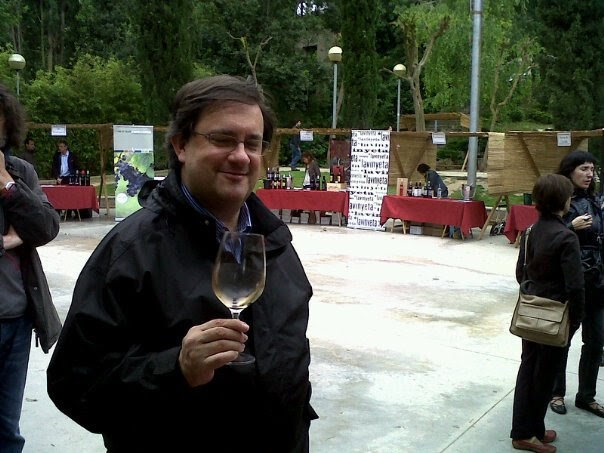
Jaume Balaguer (Lo Jaume, The Jaume (James) in Western Catalan parlance) is a many faceted man. He runs Bonviure, a wine and delicatessen shop in Gratallops (Priorat), and Celler Balaguer Cabré, a boutique winery in the same village; helps in Piró, the family restaurant; and sells to restaurants and wine shops wines from a number of small Catalan wineries. Apart from these trifling tasks, he writes a blog and is great in proposing wine-food pairings. What he does in his spare time, such as it may be, is something I have never dared to ask him.

It is about this last capacity that I wanted to tell you about. After the Tast amb Llops, my wife and I attended a pairing in his restaurant. By (lucky) chance, a few days later I enjoyed a similar occasion in a restaurant in Barcelona. That will come in my next post, to allow proper labelling of wines tasted.

Piró is a restaurant serving mainly typical Catalan food. As you know, I do not comment on a restaurant’s food unless I am disappointed. This was not the case.


The wines we tasted were the following:

Les Brugueres 2009 is a 100% Garnatxa blanca white from La Conreria de Scala Dei, DOQ Priorat, with a light golden yellow colour. Intense in the nose, with white fruit notes. Well structured in the mouth, with good acidity, and very long.

Humilitat 2008 is a red coupage of Garnatxa and Carinyena, produced by vino, amor y fantasia. Medium bodied, with lighter colour and spicy nose, its winemakers claim to have produced “the Burgundy of Priorat”. Quite true, although not a Grand Cru.

Trio Infernal 1/3 2007 is a Priorat red from 60% Garnatxa and 40 % Carinyena by Trio Infernal. Black fruit, complex nose, powerful but fine tannins.

Petit Gènesi 2009, Garnatxa, Carinyena and Syrah coming from the Vermunver winery in DO Montsant. With six months in different oaks, the nose points to black fruit and balsamic notes. Fresh in the mouth, with adequate structure.

Last but not least, La Guinardera 2006 is a 100% Garnatxa from Celler Balaguer Cabré, owned by Lo Jaume. This is no nepotism; La Guinardera is an elegant, medium bodied wine that comes from the property of the same name, an old vine plot that receives sunshine the whole day. Red fruit in the nose, with tobacco notes. Silky and long.


A perfect end for a day that included the visit to the Falset Wine Exhibition and the Tast amb Llops. Ten days later I was to have another pairing with Lo Jaume; and I was indeed looking forward to it.


http://www.vermunver-genesi.cat/en/qui_som
http://cellerbalaguercabre.blogspot.com/

2011/05/22

Scratching the wolf: Tast amb Llops

In a previous post I already commented on the fact that Catalan villages with wolves in their names tend to produce excellent wine. This time we will speak about Gratallops.

 
Philologists tell us that Gratallops means the place where wolves sing, but the straightforward translation of the name from Catalan would be scratch wolves.

 
Gratallops was the original place where the five Priorat pioneers set up their wineries and still now are producing their wines, solidly installed among the best in Priorat.

 
In these surroundings the hotel Cal Llop (Wolf House) hosts the Tast amb Llops, Tasting with Wolves. No actual animals around, but rather nine of the twenty-odd wineries active in Gratallops (not bad for a village with 260 people), plus four from other Priorat villages, and a guest from the Rhône valley, Maison Tardieu-Laurent.


In the very pleasant plaza in front of the hotel, in a cool afternoon (in many ways), with music and some tasty tapas on offer, I was able to taste and chat, and discover or find again several treasures. These were the wines I enjoyed most:
  • Celler Alvaro Palacios, the winery of one of the five pioneers, with their Alvaro Palacios Gratallops Vi de Vila (village wine, a concept resembling the parallel in Burgundy, and now being introduced in many of Priorat villages).
  • Celler Clos Mogador, with Rene Barbier, another of the pioneers, explaining his Manyetes and Solertia. 
  • Celler Clos i Terrasses, maker of Clos Erasmus, with their second wine, Clos Laurel. 
  • Celler Vinya del Vuit, with their Vuit, in its 8th anniversary. This is relevant because Vuit means Eight, the number of people working in this project, which includes names like Sara Pérez, René Barbier Jr. and Ester Nin. 
  • Celler Trio Infernal, with their Trio Infernal 2/3.
 
Alas, time flies, and I could not taste all the wines on exhibition. Better luck (or planning) next year. But at least I could scratch the wolf’s fur, tasting some of the best wines from this outstanding village.

2011/05/15

Missenyora 2009

Missenyora is one of my favourite whites of Costers del Segre and I come back to it regularly. 100 % Macabeu, fermented and aged for six months on its lees in new French oak, in the glass shows a bright, pale straw yellow. In the nose it is flowery, also with citric notes and well integrated wood. Off-dry in the mouth, silky, crisp, with long finish. Production limited to twelve thousand bottles.


It is produced by L’Olivera, a cooperative that provides jobs for the mentally challenged. They have a range of white, sparkling, red and sweet wines worth exploring, not to mention top quality olive oil.

At a price of around 11 EUR, the QPR is outstanding IMHO.

The wine’s name (My Lady) is the title of the Abbess of the nearby Cistercian Monastery of Vallbona de les Monges, really worth a visit, together with Poblet and Santes Creus, which configurate the Cister route in the zone. As may be expected, all three have remarkable wines produced in their immediate surroundings.


Vallbona de les Monges monastery

2011/05/10

Wines at Torrelles

The village of Torrelles de Llobregat, 20 km west of Barcelona in the first hills of the Garraf massif, is not famous for its wines; rather, its cherries (and those from the surrounding villages) are prized in the Catalan markets. However, and for the second time, David González (Vinoscopio) has gathered a group of winemakers in the Torrelles Wine Fair that amply reward inspection.

Up to four groups of wineries (apart from high quality beer, cheese, cold meats and pastry producers) were available: 
  • Natural wine producers 
  • Wineries from a selected “special guest” wine zone; from Torroja in Priorat this time 
  • Wineries represented by smallish wine distributors 
  • Other wineries collaborating with Vinoscopio
All producers were small, some of them still cutting their teeth, and giving a good representation of their terroir. David has a detailed knowledge of the grass-roots wine world, especially Catalan, and a fine nose to detect potential stars.
Unlike more publicized events, this fair has a human scale and allows a short chat with the winery representatives, usually the owner or winemaker, given the size of most enterprises. For an amateur like me, it is a great opportunity to learn and make useful contacts to visit later.

Happy me at the opening tasting Miliarium blanc
I had only three hours and could not taste all wines and meet all winemakers. But I certainly liked some enough to purchase a bottle to be able to enjoy them at home:

Cava Berdié, a young Cava winery in Castellví de la Marca with a modern approach based nonetheless in traditional grape varieties and managed by three enthusiastic siblings. 


Miliarium, an engaging public-private project in Ulldecona that pools vineyards no longer farmed by their owners (usually old people with no children interested in the wine world) and employs young people. In the able hands of oenologist Juan Manuel Gonzalvo, it is a project to track closely. 


Mas de la Caçadora, a Els Guiamets, Montsant winery with a wide range of wines; I especially liked their Garnatxa Blanca sweet wine and a most tasty, enjoyable rosè. 


Rampell, from Torroja, Priorat, the project of Cristian Francès, Trio Infernal oenologist, with a very personal Chenin blanc and also a striking red. 

Celler Aixalà-Alcait from Torroja, Priorat, with highly regarded red wines. 


Celler Sabaté Franquet from Torroja, Priorat, with their first wine, promising coming from young vines.


Llicorella Vins from Torroja, Priorat, with a range of three reds. I took a bottle of the most aged and complex, the one I liked best (perhaps I am aged and complex myself!). 


Celler Ronadelles, a biodynamic winery at Cornudella del Montsant, DO Priorat. I enjoyed especially their red from old vines and a sweet from Garnatxa roja.


There were other wineries I like, but these were for me the highlights of a fair with a very consistent level. Surely an event to write down in the agenda of the seeker of uncommercial, terroir driven wines, looking for nice surprises and a sound QPR.


http://www.doqpriorat.org/eng/index.php
http://www.domontsant.com/
http://www.cavaberdie.com/
http://pardelasses.blogspot.com/
http://www.llicorellavins.com/
http://www.masdelacasadora.com/index.php/en
http://www.ronadelles.com/en/index.php
http://www.adictosalalujuria.com/

2011/05/05

Carinyenes at Porrera

In my last 2010 post I explained my views on public wine tasting events and mentioned some of them I had already attended.
 
The Priorat and Montsant Wine Exhibition (Fira del Vi) in Falset mentioned there is a major mass attraction that is surrounded by smaller, more selective events that are worth attending. From Friday April 29th to Tuesday May 2nd the wine lovers (that can spare the time and cost) have their hands full with tastings, pairings, presentations and winery visits. I was able to attend a few of them, and in the upcoming posts I will endeavour to tell you about my experiences.


In the village of Porrera, already mentioned elsewhere in this blog, are located some of the oldest and finest Carinyena vines in the Priorat DO. In many cases, they are processed separately from other grapes, and the coupage is made just before bottling. Few Porrera wines, however, are pure Carinyena; usually the blend contains also Garnatxa and perhaps Cabernet Sauvignon, Merlot or Syrah.
 
Porrera wineries offer a unique opportunity every year at the “Carinyenes a Porrera” tasting. They present their best pure, unblended Carinyena wines before the coupage is done. Of course, in many cases the wine comes directly from the cask, without any bottle aging; however, the potential is there, and is very rewarding to taste them and have an inkling of what the wines in which they take part will be like.

One surprising aspect of this event is that is somehow illegal. Not that tasting wine is forbidden in Priorat; rather what is forbidden is the commercial use of the word Carinyena to name the grape varietal, because there is an Aragonese village, Cariñena, in the DO of the same name. Silly enough, but the wineries usually have to resort to the name Samsó, which is in fact another grape (some say the one named as Cinsault in France) or devise misspellings such as Caranyana. But if you ask the old winegrowers basking in the sun in the village square, they will tell you they have farmed Carinyena vines since childhood…
 

There were over twenty-five wines from eighteen different wineries; it was not the time or place to take down detailed notes of each, but I can name the ones that pleased me most:
Many wines, but all of them different, as a result of the microclimates of each plot, the age of the vines and the winemaker skill. A feast for Carinyena lovers, showing that this variety, often despised as unrefined, when in proper conditions can yield great wines.


2011/04/24

Ferrer Bobet and Joan Simó: two strategies

In the village of Porrera, as in the rest of Priorat, there are few wineries, apart from cooperatives, that have been in business as such for more that twenty years, when the Priorat revolution started. Modern Priorat wineries can be divided in two groups, which I think are well represented by the two Porrera enterprises I will now describe.
Ferrer Bobet winery
Ferrer Bobet is a joint venture between Sergi Ferrer-Salat, owner of one of the largest Catalan pharma companies and acknowledged food and wine enthusiast, and Raül Bobet, famed oenologist at Torres. They purchased land over the winding road that leads from Porrera to Falset. There they planted 20 hectares of Garnatxa, Carinyena, Syrah, Cabernet Sauvignon and Viognier, and built a spectacular, if discrete, cellar with a distinctive semicircular glass walled tasting room with fabulous views.

Stunning panorama from Ferrer Bobet tasting room

Grapes from these new plots are not yet used: vines are too young. Rather, Ferrer Bobet buys grapes from selected vinegrowers that organically farm costers planted with old Carinyena and Garnatxa. Grapes are harvested manually in small boxes, taken immediately to the winery and stored at 3 ºC. Grapes are then selected manually before destemming and after.
Inside of the cellar, and mainly underground, the latest technology and stainless steel combine with the best wood to enable organic winemaking with gravity powered wine movements. The pharmaceutical background of Sergi Ferrer (I am also in the pharma industry) shows in the attention to cleanliness and the careful choice of materials in contact with wine.

Ferrer Bobet
Fermentation takes place in smallish oak vats, allowing separation of individual vineyards. Later on wine ages for fifteen to eighteen months in new French oak and twelve months in bottle.

Ferrer Bobet
Ferrer Bobet produces only two reds, both coming from the old vine costers:  

  • Ferrer Bobet, with about two thirds Carinyena and on third Garnatxa, with the occasional sprinkling of Cabernet Sauvignon or Syrah
  • Ferrer Bobet Selecció Especial, with over 85% Carinyena and the balance for Garnatxa.
The winery produces a total of around 25’000 bottles of these intense, elegant, mineral and fruity reds.

Joan Simó is a winery located in the centre of Porrera, in a two hundred year old house, complete with sundial. Gerard Batllevell Simó, the owner, farms land from his family and also other plots more recently purchased. In 1999 and 2000 he planted Garnatxa, Carinyena, Cabernet Sauvignon and Syrah in La Garranxa, a plot that had been barren since the phylloxera onslaught.

Joan Simó winery

Winemaking facilities are located in the lower part of the Porrera house, with the dimensions of a garage winery. Still active, Gerard's uncle gives advice and produces a superb ranci, or oxidized wine, that unfortunately is not for sale.
Gerard makes three wines, all red: 
  • Sentius, from Garnatxa, Carinyena, Cabernet Sauvignon and Syrah from La Garranxa. Fifteen months in French oak. 
  • Les Eres, the flagship of the winery, is made with grapes of four different plots, using Garnatxa and Carinyena eighty to ninety years old, and some younger Cabernet Sauvignon. The wine is kept for eighteen months in new French oak. 
  • And since 2006, Les Eres Especial Els Carners, 550 bottles coming from the Els Carners plot, planted ninety years ago with Garnatxa and Carinyena (75/25). Two barrels, one of Allier and the other of Tronçais oak, hold the wine for eighteen months.
All three are dark, concentrated, complex examples of Priorat. Total production of around 20'000 bottles.

Joan Simó
The two different ways are clear. On one hand the external money from a wealthy wine lover that is invested intensively, starting with a spectacular winery and building the wine later. What we call in Catalan to start building the house by the roof. On the other, the local step by step approach, using money only when needed and not before, utilizing old village houses and vines from the family or purchased at the cost of personal involvement.
Which is best?
 
I tend to judge them looking at two variables mainly: the impact on the land and its economy and, of course, the quality of the wines. For the first group, respect to the environment and to free trade, trying not to dominate the market, and contributing to local economy can have a very positive impact. The second strategy permits in the long term local accumulation of wealth and better prospects for the young.
Ferrer Bobet
I think we can find examples of better and worse wineries in both groups. In the first, I find that much depends on the personality of the capital provider. If he is personally involved, has not invested a critical part of his wealth and has the good sense to listen to expert professionals, chances are good. If some of these conditions are not met, and a crisis pushes the market down, chances of survival are slim, as can be seen just now in some sad cases. 

In the second group, chance of survival is more linked to the quality of the wine and the way it is marketed, often the great weakness. 

Ferrer Bobet

A third way is when foreign winemakers invest, but I think they tend to be more cautious and mimic the step by step approach of the locals, I do not know if out of experience or lack of money.
For me, a good blend of strategies is likely to benefit Priorat (or any other zone in a similar situation) and the wine lovers. Ferrer Bobet and Joan Simó do.


2011/04/18

Can Feixes, a château in Penedès

The Can Feixes seal
Fifteen years ago I visited Can Feixes. For some time I had appreciated the quality of their wines, and I wanted to see the source. The owner, a delightful old school gentleman (he was an architect by training), showed us his property with enthusiasm and explained his plans for the future.

 
Fifteen years later, Mr. Huguet is, regretfully, no longer there to steer the course of the winery
 
It is easy for the successors, in these cases, to either let the enterprise languish and eventually die, or to completely change the spirit and philosophy, with uncertain results and the assurance of losing the former charm. The fact that not one heir, but three, have to take decisions makes all even more difficult.

Old and new together

 
However, his three sons have come up to scratch splendidly. The Can Feixes philosophy remains; they concentrate on their land and grapes, respect the environment both in the vineyard and the construction of the winery, and stick to their six proven and mastered wines. Josep Maria looks after winemaking; Joan is in charge of the vineyards and Xavier takes on administration.
 

The old winery

The name comes with the property. Can Feixes means house (the physical building) of the Feixes family. And it was so at least from the late fourteenth century till beginning of the twentieth, when the Huguet family took over after the Feixes extinguished. The property has some beautiful old buildings, including the one that houses the old winery, now a showpiece, with the door with the seal that can be seen on bottles.

 
The Huguets respected the complex and have enlarged the winery mostly underground, with room for cask and bottle cellaring; in this way, the buildings look from outside pretty much the same as a century ago.

Bottle cellar

 
In the rear, the distinctive peaks of Montserrat
The estate, in the hilly northern part of the Penedès DO, has over 350 hectares, 80 of them under vine. Medium height over sea level is 400 meters, and soils mainly rich in limestone, with varying slate and clay additions. Temperature, being the estate higher and farther from the sea than most of Penedès, shows a bigger difference between day and night, beneficial for slower maturing of the grapes and better acidity.

Old parellada vine

Old Parellada vineyard

On the selected plots most suitable for each, Chardonnay, Merlot, Cabernet Sauvignon, Pinot Noir, Malvasia de Sitges, Ull de Llebre and Petit Verdot grow on trellises, together with older (70 year) bush grown Parellada and Macabeu old vine plots. Wines are organically farmed and produced; the seal of the Catalan Council for Ecological Production (CCPAE) will start appearing on the 2010 bottles.
Vineyard with planted vegetation in between rows
 
The estate can be compared with a Bordeaux château, with the winery sitting in the middle of the vineyards. In this way, the grapes, manually harvested and having undergone a first selection in the vineyard, reach the winery in minutes where they are again selected and enter the processing stage. The white varieties are fed into the pneumatic press without breaking the grains, so the first must to come out is of the highest quality.

 
The still wine range has four items: 
  • Can Feixes Blanc Selecció, a white made from Parellada, Macabeu, Chardonnay and Malvasia de Sitges (40/30/20/10), unoaked, light and fruity with citric notes 
  • Can Feixes Chardonnay (100%) fermented and aged for eight months in new French oak and twelve months in bottle. White fruit and well integrated wood. 
  • Can Feixes Negre Selecció, a red Merlot, Cabernet, Ull de Llebre and Petit Verdot (40/25/25/10) aged for seven months in tank and twelve in French oak. Dark red, with minerality and red fruit to balance more tertiary wood and coffee aromas. 
  • Can Feixes Negre Reserva Especial, the top wine made from Cabernet Sauvignon and Merlot (80/20) especially selected grapes and only in the best years. Aged for 14 months in new French oak and at least four years in the bottle. Dark cherry, elegant and complex aromas of ripe red fruit, balsamic, spice and wood, and a long finish.
 

Like many other Penedès wineries, they also produce Cava, with the Huguet brand. In fact, although in the market you can find both Huguet Gran Reserva Brut and Huguet Gran Reserva Brut Nature, it is essentially the same wine: a rather uncommon Parellada, Macabeu and Pinot Noir blend (50/26/24) aged for six months in tanks before second fermentation and at least thirty months after. Brut receives a small quantity of sugar after degorjat and Brut Nature does not. Both have the distinctive small, persistent bubble and creamy aromas of Gran Reserva Cavas; the degree of sweetness (not at all or very slight) will determine the choice.
 
A finishing point: wines leave the winery ready to drink; no further cellaring is needed; all bottles are numbered, and those of Cava show the date of degorjat, something which is, unfortunately, not mandatory, but shows compromise to quality, in line with the philosophy of Can Feixes.


http://www.crcava.es/catala/flash.html