Showing posts with label Vintaix. Show all posts

2011/04/10

Gobe's friends

In the early eighties little Josep Barceló, still too young to read, would identify the peg to hang his coat on at his Priorat school by a drawing of a mushroom (“rovelló”) over it. In his childish speech, he would not pronounce the “r” sound properly, so his schoolmates promptly nicknamed him “govelló”, later shortened to Gobe.
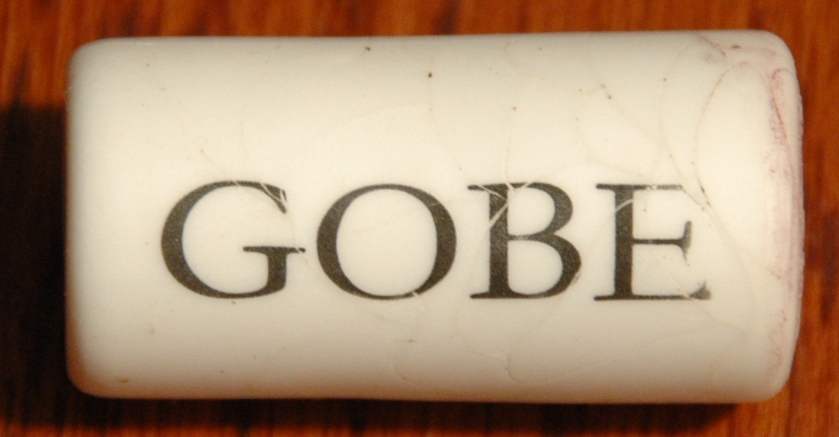


Gobe grew up among his friends, meeting them also after school to play football (their team was called “La Xusma”, the rabble), and, later on, to share a bottle of wine. In due time, many of them worked in the world of wine; Gobe himself at the Celler de Capçanes, while planning to make wine from a small family vineyard farmed by his uncle.

Sadly, in 2004 Gobe died in an accident. A few weeks later, his friends visited Gobe’s family and suggested making the wine Gobe dreamt of, as a common effort, in a non for profit way, as a tribute to his memory. The twelve friends, with the help of Gobe’s uncle and brothers, would endeavour to make Gobe’s wish come to reality.

And so it did.

Amics del Gobe (Gobe's friends) was on its way.

The vineyard is in the Montsant DO, at a height of some 300 m: 1 hectare of sandy soil with 80-year old Carinyena and some new Garnatxa, farmed organically. Grapes undergo a first selection in the plot, are gathered in 12 kilo boxes and taken to the Venus La Universal winery, where a second selection is made before starting the winemaking process.

After destemming and 20 days of contact with the skins, the wine goes to second year 300 l French oak casks, where it stays for twelve months.


The wine itself is a good example of Montsant red. Dark cherry colour, with slightly tinted legs. In the nose red and black fruit, not overripe, with tobacco and balsamic notes. Not too much wood, letting the fruit shine. Tannins still noticeable, good structure in mouth, with a long finish. A very pleasant, straightforward, drinkable wine.

The output being around 1’000 – 1’800 bottles, it is not easy to secure one. I got mine in a visit to Gratallops, in the Bonviure wine and delicatessen shop, where Jaume Balaguer showed me his small winery (more on that on another post) and other small gems he has.

What is the future of this initiative? In the short term, the 2009 vintage will start to include some wine from the Carinyena planted in 2005. This will allow to eventually increase output to a maximum of 3’000 bottles. And with the support of winelovers, Gobe’s friends intend to go onforever; a support not so difficult to give, because at around 10 EUR per bottle the quality / price ratio is excellent.

Any of you interested in further details can join the Gobe group in Facebook or have a look at the video in Vintaix (see links below).

Perhaps from somewhere Gobe still looks after his vineyard…


http://www.facebook.com/home.php#!/group.php?gid=181198642078&v=wall
http://vintaix.com/comunidad/blog/2009/12/10/els-amics-del-gobe/

2011/01/30

Vintaix Magnum Rave

Do not be confused; I do my best not to praise extravagantly any wines, and I hope I am not starting to lose my head. It is rather a wine tasting I attended recently, which its organizers, Vintaix, call Rave. It was not a wild party, as the name may suggest, but certainly informal, with live jazz and fluid protocol, and ably led by Miguel Figini.

The first wine of the night was a DO Cava: Castellroig Brut Nature Gran Reserva 2005. This Cava was explained by its winemaker, Marcel Sabaté, who stressed his obsession with terroir and its combination with a given grape variety.

The wine, as a Gran Reserva should, showed developed secondary aromas of bread and croissant, together with a very fine, well integrated and persistent bubble. It comes from a coupage of old-vine Xarel.lo and Macabeu, with no less of 36 months aging. This is not the ideal Cava for a refreshing single glass, but rather a great wine to pair with a full meal.

The second wine was a Petrea blanc 2003 barrel fermented white from the Mas Comtal winery, DO Penedès. It has mainly Chardonnay with a dash of Xarel.lo, with 10 months of Hungarian oak. The colour was a developed lemon yellow, not surprising since it was from the 2003 vintage. In the nose it was understandably closed at the beginning, but with time it developed aromas of butter, white fruits and a hint of wood, with some mineral notes at the end. In the mouth it confirmed the aromas detected; it was unctuous, still fresh and with a long finish. It showed the master hand of one of the leading Penedès winemakers, the late and lamented Joan Milà, who died prematurely last year.

The first red came from DO Empordà and the Espelt winery. Terres Negres 2007 is a blend of Cabernet Sauvignon and Carinyena, aged twelve months in French oak. Deep cherry colour, with the oak evident in the nose, along with ripe fruit. In the mouth it is well structured, somewhat oaky, with enough tannins and acidity to keep for several years, when it will probably show greater balance.

Signes 2008 is a DO Catalunya red from Bodegas Puiggrós, in the town of Òdena. It is composed of Sumoll and Garnatxa coming from 60+ years vines. Sumoll is a local grape variety that all but disappeared and is now being revived by a handful of wineries, using modern winemaking techniques hitherto never available to Sumoll wines. The old vines, still grown as bushes, are harvested manually and the grapes are collected in small boxes. Aged in French oak for ten months. Deep red, with aromas of toast and spices, with kaleidoscopic evolution in the glass after a few minutes of swirling. In the mouth also show up citric fruits and licorice; excellent balance. Explaines by its enthusiastic winemaker, Josep Puiggrós, it shows how Sumoll wines can be in the future.


Moving now to DO Montsant, we sampled Dosterras 2007 from Celler Dosterras. It comes 100% from 100+ years old Garnatxa vines, harvested manually in 10 kg boxes and aged for sixteen months in French oak. Intense red, with fine legs, there is black fruit and minerality and flower aromas; with a very smooth mouth, freshness and an excellent balance with the wood notes.


The last red was one of the DOQ Priorat pioneers, Clos Martinet 2004 from Mas Martinet. As Magí Batllevell explained, it has 40 % Garnatxa, and 20 % each of Carinyena, Cabernet Sauvignon and Syrah, aged in French oak for sixteen months. Very deep red with few signs of evolution. As for aromas: very mineral, balsamic, black fruits, coffee and toast notes. It fills the mouth, with still noticeable acidity, noble tannins, velvety, long lasting.

After the tasting I had the opportunity to discuss with Silvia Naranjo some of the comments I made on the Guide of Catalan Wine in a previous post. An appropriate end to the Rave, an experience I hope to repeat soon.


http://www.crcava.es/catala/flash.html
http://www.do-catalunya.com/english/engmenu.html
http://www.doemporda.com/index.php?action=presentation
http://www.domontsant.com/
http://www.dopenedes.es/en
http://www.doqpriorat.org/eng/index.php
http://www.castellroig.com/
http://www.mascomtal.com/eng/index.php
http://www.espeltviticultors.com/
http://bodegaspuiggros.com/4/
http://www.dosterras.com/english/index.html
http://www.masmartinet.com/
http://vintaix.com/comunidad/